 „You applied for the position of an MEP. What made you take this step?“
Dr. Helga Trüpel, Bündnis 90/ DIE GRÜNEN (GRÜNE/EFA)
„I have been an MEP for the German green party since 2004. The European level is where the relevant decisions for our future are made: climate policy, energy policy, preventive foreign policy.
The green party wants to have a decisive role in this and to do so, we need a strong European parliament.
As in all democracies, an important task of the parliament is to check the council and the commission.“
Martin Schulz, SPD (PSE)
„I went into politics because I wanted to change something and fight for a better world, which is still my aim. In 1974 this made me join the SPD (German social democratic party) and I got involved in the young social democrats. For the SPD kept pursuing the same goals for over 140 years, passionately and successfully: Justice, democracy and solidarity, peace and international cooperation. First I became a member of the Würselen city council in 1984, from 1987 to 1989 I was the mayor. I grew up close to the Belgian and Dutch borders. Europe is happening there and a part of everyday life. I am a convinced European, Europe is a fascinating concept of peace, stability and social justice that is worth fighting for.“
Dr. Anja Weisgerber, CSU (EVP-ED)
„I was already interested in politics at school. And you can change a lot, especially on the European level. For instance, 80% of environmental issues, one of my personal focusses, are decided on the EU level. Therefore, I consider working in the EU parliament a unique opportunity to fight for the environment.“
Holger Krahmer, FDP (ALDE)
„I had been politically involved for years, organised information booth and public operations, participated in discussions – even reading the newspaper can lead to political debates when I am around. I am annoyed by too many laws no one can see through anymore, by the EU using our taxes to finance farming rather than universities and research programmes, by stinking smokestacks that keep polluting areas in spite of strict laws, for instance at the border between the Czech Republic and Saxony. And if you do not want to wait for others to take care of it, you have to become a politician yourself. So, this is how I became an MEP.“
Feleknas Uca, Die Linke (KVEL/NGL)
„Mainly, I always felt the need to stand up against injustice in this world, for instance against the fate of all people living in grinding poverty or to who freedom of speech is denied. But apart from this it was my experience as a German woman of Kurdish heritage with everyday racial prejudices and distrust that made me go into politics. By working in the European Parliament I can really make a difference.
Even though my group, which is one of the smaller ones in parliament, can not always push its demands through the ballots, it is important to introduce leftist ideas and policy to Brussels and give people first-hand information on European politics.“
 „Why did you apply for the European parliament rather than a national one?“
Dr. Helga Trüpel, Bündnis 90/ DIE GRÜNEN (GRÜNE/EFA)
„Because „green“ topics such as climate, environmental issues and regulating the market are the ones you can only properly influence on the European level, not on the national one. We want Europe to be led by its citizens, not by its governments. This means that the MEPs have to represent the citizen's interests in Brussels and Strasbourg.“
Martin Schulz, SPD (PSE)
„Because I believe in the European project – both in its past and future achievements. By means of regional integration we managed to give peace to a continent that was shaped by precarious power equilibriums and devastating wars for centuries. Losing the fear of war and the open borders in Europe are a dream of mankind come true. The European peace project is a breathtaking success we should not allow to be belittled. We must not let people say that this is history. Peace is always endangered most when you take it for granted.
A look to the future shows that the EU is the key to coping with the challenges of a globalised world.
With its 27 sovereign states, its nearly 500 million citizens, its economic power as the world's biggest domestic market, the EU can achieve way more internationally than the nations themselves ever could.
We have to use this power to make globalisation fairer and lasting, at home and in the rest of the world.“
Dr. Anja Weisgerber, CSU (EVP-ED)
„Because the importance of Europe keeps increasing and many transnational challenges – such as climate policy – must be dealt with on the European level. I spent years working for environmental policy as the leader of the working team on environment and energy of the „Junge Union“ (youth organisation of the Christian Democratic Party). So working on these issues in the parliament is really exciting. Europe is an exciting work place where you can change a lot, even as a single delegate.“
Holger Krahmer, FDP (ALDE)
„Nowadays, Europe is the place where the big decisions are made. As an environmental politician, Berlin or Dresden would only allow me to fineadjust things, the laws themselves are passed in Brussels.“
Feleknas Uca, Die Linke (KVEL/NGL)
„Nowadays, the European Union is very important and influencial worldwide, especially in its neighbour states striving for membership or special relations to the EU. My aim is to use this influence to establish real democracy and constitutional legality in these countries. Unfortunately, most of the European politicians prefer to deal with other issues, e.g. defending Europe against illegal refugees from Africa or the middle east. Also, I want to do my share to create a tolerant and multicultural Europe.“
 „Are there any issues you feel responsible for in particular?“
Dr. Helga Trüpel, Bündnis 90/ DIE GRÜNEN (GRÜNE/EFA)
„Cultural diversity and intercultural dialogue, worldwide acknowledgement of the human rights. Also, I try to support ecological arguments concerning the EU budget such as the „Green New Deal“, investing in environment and climate protection and in education, that is. This is why I am vice president of the committee for culture and education, member of the delegation for China and my party's spokesman for budgetary issues.“
Martin Schulz, SPD (PSE)
„The fight against fascism, intolerance and racism are special concerns to me. The EU was founded to end the racist madness of fascism, hate against minorities and intolerance. But today, right extremism shows its ugly face again in many areas of Europe. Xenophobic, racist and homophobic violence is increasing. The extreme rightists of Europe provoke the society day after day, always testing how far they can go. We must not tolerate this.
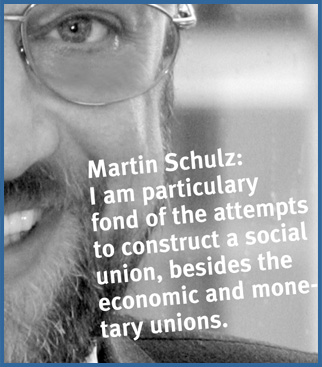
As a social democrat, I am particularly fond of the attempts to construct a social union besides the economic and monetary unions. The European model of success has always been to make economic and social progress two sides of the same medal. The conservative, liberal governments deregulated the financial markets for too long, which few benefitted from. The current economic crisis shows us what this led to, even conservative and liberal radical free market advocates realise that sometimes the markets are the problem and policy the solution and rediscover social models. Our future task is to create a financial and economic order for Europe centred around the people, not the market.“
Dr. Anja Weisgerber, CSU (EVP-ED)
„The emphasis of my work is on environmental, social, health, and consumer protection policy. In these fields I try to highlight the interests of the middle class, as they are the backbone of our society. Apart from that, I consider myself an advocate of my home region Franconia and of the younger generation.“
Holger Krahmer, FDP (ALDE)
„Security or environmental issues are often connected to fear and personal concernments. This
is something that affects politicians too. But generally, I prefer to make decisions with my head rather than my guts. I consider it an important task to keep instisting on objectivity. Laws have to be designed to achieve their goal, not to just calm people down. Often, laws are there to ban something.
But you have to be careful with bans because freedom is a precious thing for all of us – be it traffic regulations, the height of the tree in front of your house or the right to speak your mind freely.“
Feleknas Uca, Die Linke (KVEL/NGL)
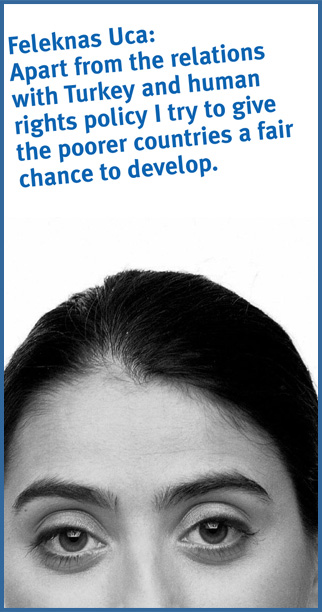
„Apart from the relations with Turkey and human rights policy, I try to give the poorer EU countries a fair chance to develop, by means of fair trading relations or a better development cooperation that also strengthens and acknowledges the role of women in these societies.“
„What do you think is the role of young people in the European Union?“
Dr. Helga Trüpel, Bündnis 90/ DIE GRÜNEN (GRÜNE/EFA)
„The only way for the European project to have a future is to convince the younger generation of its importance. The elderly still remember war and poverty and Europe always stood for a more peaceful future. But nowadays, this is just not enough to cast a positive light on Europe anymore.“
Martin Schulz, SPD (PSE)
„The lives of the 75 million Europeans that are between 15 and 25 today is massively affected by European decisions and trends. These set the chances and risks in their education, their occupations and many other aspects of their lives. The younger generation will inhabit the future Europe, you can not be a politician and a father without considering this. But I am curious how today's youth will shape Europe after I retire.“
Dr. Anja Weisgerber, CSU (EVP-ED)
„To me, youngsters are very important for the EU. They are its future. They decide how the story goes on.“
Holger Krahmer, FDP (ALDE)
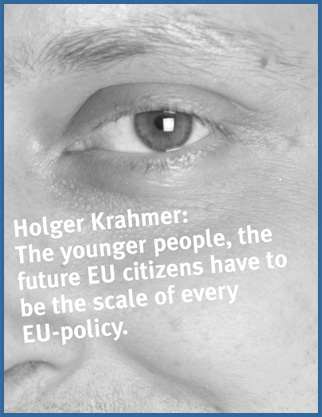
„Of course, young people are the ones I work for!! It would be egoistic to think of nothing but of here and now. The younger people, the future EU citizens have to be the scale of every EU policy. I try to fight for and maintain as much freedom for them as I can, keep the government from making too many depts they will have to pay and stand up for the kind of Europe that is a nice place to live in.“
Feleknas Uca, Die Linke (KVEL/NGL)
„The European Union tries to directly approach youngsters with publications, websites or events. I think it is important to take them serious with their expectations, ideas and doubts about politics. This is why I support a minimum voting age of 16, also for permanent residents without an EU citizenship.“
 „Why should young EU citizens vote for you? What will you accomplish for them?“
Dr. Helga Trüpel, Bündnis 90/ DIE GRÜNEN (GRÜNE/EFA)
„In Germany, education is something the federal states deal with, but you can also change things on the European level to make it useful for the future. And the fight against climate change mainly affects young people because they will have to deal with the effects of global warming a lot longer than my generation. And climate protection is something you can only do on the international level.“
Martin Schulz, SPD (PSE)
„We want a strong and socially just Europe. A politically powerful, economically successful and socially just Europe gives us the chance to make globalisation fair and lasting – in Europe and in the whole world. For us, the people matter and not the market; this is why we demand a social union, an examination of all EU legal acts with regard to their social consequences, a European pact against wage dumping and for minimum wages.
We demand a new financial architecture with clear political rules to make sure such a crisis will never happen again. We want Europe to be a strong peace power giving new impulses to an increasingly multipolar world. A strong and social Europe is the best guaranty to accomplish the challenges of the 21st century.“
Dr. Anja Weisgerber, CSU (EVP-ED)
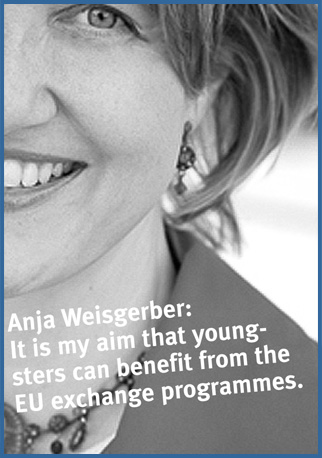
„I am working for a lasting environmental policy. A responsible handling of nature is the only way to let today's youth and the following generations enjoy an intact environment. I also fight for the youth's benefits of the European domestic market, the reciprocal acknowledgement of academic degrees and training qualifications and EU exchange programmes.“
Holger Krahmer, FDP (ALDE)
„My aim is to make sure that young people in Europe get an excellent education and, later, good jobs, to let them live in a clean environment and enable them to enjoy their personal rights. This is something that sets me apart from the other politicians: I do not aim to pass more bans and laws. These constraints are the last step that should be taken to achieve a political goal after everything else has proved futile.“
Feleknas Uca, Die Linke (KVEL/NGL)
„In the last years the state increasingly denied its social responsibility and constrained free access to education, e.g. by introducing tuition fees. The European Union supported this by demanding privatisation and economic competition. My aim is to make the EU support solidarity, peace and a lasting resource policy instead, for our generation as well as future ones. I need your support to be able to keep representing the interests of youth in Europe.“
 „Since the first EP elections in 1979, voter turnouts in Germany decreased for almost 20%. This makes campaigning and informing more and more important. What do you do to spark young voter's like me interest in the elections in June 2009 in particular?“
Dr. Helga Trüpel, Bündnis 90/ DIE GRÜNEN (GRÜNE/EFA)
„I try to make them understand that they are the ones who will have to continue the European project in the near future. You have to create the kind of Europe that you want to have. You are Europe!“
Martin Schulz, SPD (PSE)
„It is weird that, while two thirds of young Europeans have a very positive attitude about the EU and support the membership of their countries, the voter turnouts of young people are the lowest. In Germany, only 30,5% of the 18-25% voted at the EP elections in 2004. I already commented our agenda, but politics are no one way street. My party finds it important to exchange ideas with young people. Politicians often talk about the importance of youth but do little. We try to establish possibilities for participation and new communication channels. For instance, the EP's social democrats organised a three-part conference entitled "The Young European Dream - Listening to Europe´s Youth", inviting young people from all over Europe. The internet and new social networks enable exciting, formerly unknown forms of civic engagement, mobilisation and information, making true interactivity and dialogue become reality. Increasing numbers of people use our youtube channels and podcasts, post messages in our forums or become facebook friends of our delegates. Everybody is warmly invited to join the discussion.“
Dr. Anja Weisgerber, CSU (EVP-ED)
„By informing as many people as I can. I visit a lot of schools, universities and trade schools in Lower Franconia. Just a couple of weeks ago I participated in a big youth conference in Würzburg where youngsters had the opportunity to ask EU politicians questions. In these cases, it is my aim to show the audience their benefits from Europe; such as the diverse EU exchange programmes for students and apprentices, free and uncomplicated travelling through Europe or the lowering of the roaming fees for using mobile phones abroad.“
Holger Krahmer, FDP (ALDE)
„Since my first election in 2004 I kept visiting schools, universities and youth centres as often
as I can. Election posters and glossy leaflets are the wrong way to advertise Europe. Nothing can replace face-to-face contact. I try to mention as many cases as I can where a vote at the EP elections could lead to concrete changes in one way or another. For instance, the European Parliament participates in transportation, development and environmental policy, to name a few.“
Feleknas Uca, Die Linke (KVEL/NGL)
„Polls show how dramatically voter turnouts depend on the estimated importance of the respective institution. This is where I try to enlighten people, youngsters and young people in particular. I try, e.g. by inviting school groups to the European Parliament, joining public discussions or visiting schools, to enter into conversation with young people, to answer their questions and get to know their opinion on topics that concern them. They are often amazed how easy it is to get politically involved and how important it is because it directly affects our lives. It is also important for the European Parliament to get more participational rights in the future, e.g. by having a say concerning all commissionary initiatives and propose initiatives itself.“
„An election always depends on reciprocal interest. You already told us what you want to achieve for young EU voters. To conclude, what would you like youngsters to do concerning the European Union?“
Dr. Helga Trüpel, Bündnis 90/ DIE GRÜNEN (GRÜNE/EFA)
„A bigger interest in European matters; the will to get to know Europe, for instance by joining the Erasmus exchange programme; tolerance and solidarity.“
Martin Schulz, SPD (PSE)
„Ich would like them to get into this adventure called politics and the European Union. What seems technical, bureaucratic and boring at first sight often turns out to be exciting. Sometimes it is about big questions like reversing climate change, sometimes it is just common issues like roaming tariffs for mobile phones. But we always discuss what our lives, our world and our future should look like. As I said, politics are no one way street – therefore, I would like youngsters to talk to us about their wishes, anxieties and ideas.“
Dr. Anja Weisgerber, CSU (EVP-ED)
„I would primarily like them to vote on the 7th of june. Only voters can participate in decisionmaking. Democracy depends on participation!“
Holger Krahmer, FDP (ALDE)
„What a wonderful question! I would like them to be curious and open-minded. Keep an eye on your European representatives, watch every step they take! Even when the elections are over, you can still get involved, email the delegates and point out mistakes or ask for the consequences of certain EU decisions. Tell them when they make mistakes, but also tell them what they did right. Thus, Europe will be what it ought to be: Something everybody is talking about.“
Feleknas Uca, Die Linke (KVEL/NGL)
„I know that youngsters often feel that they can not see through political processes well enough to make the „right“ choice. However, an election is a good occasion to inform yourself on the party's and candidates' aims open-mindedly. Often, non-government organisation such as amnesty international, Greenpeace or working unions comment on the manifestos. But the European politics need the motivation and curiosity of young citizens constantly informing and involving themselves. And direct questioning of politician and local federal or even Europe-wide protests can change more than many people think.“
The interview was conducted by Katharina, Germany